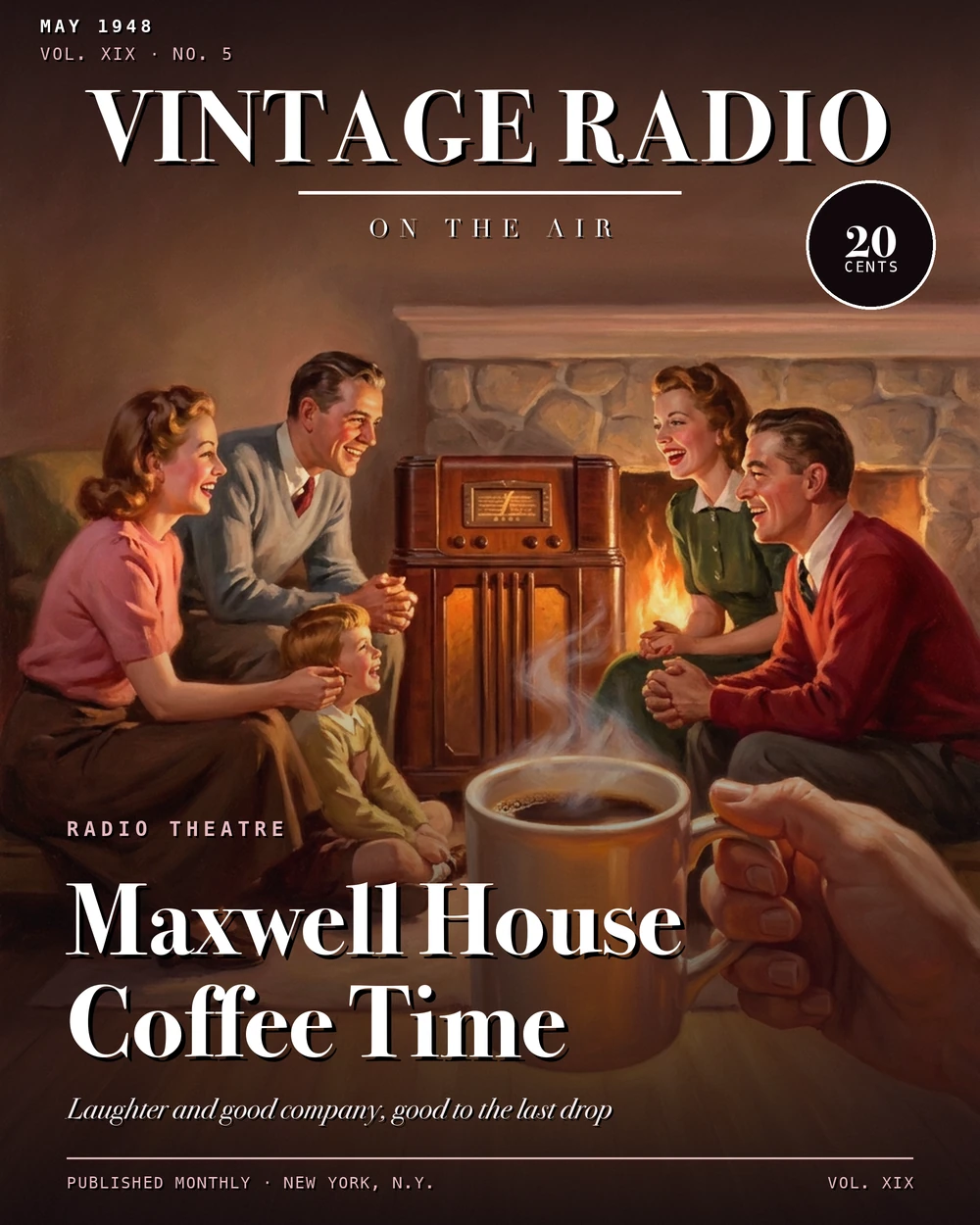
Maxwell House Coffee Time
How It Got on the Air
Maxwell House Coffee Time didn't start with that name. Its roots go back to November 4, 1937, when NBC launched Good News of 1938, a variety program with MGM's backing. Over the next few years, as the calendar turned, the show updated its title to Good News of 1939 and then Good News of 1940. When General Foods Corporation — the real sponsor behind the Maxwell House brand — eventually dropped the MGM tie-in and trimmed the show to thirty minutes, the title changed to match the product: Maxwell House Coffee Time. That transition was formalized on January 2, 1941, when Frank Morgan joined the cast and the Good News name was retired for good.
The relaunch registered with audiences right away. Ratings jumped to 23.4, putting the show in ninth place overall and making it the most popular program on Thursday nights. That's a fast start for what was essentially a repackaged version of a show that had been running for three years. The new title, the new format, and Morgan's presence clicked with listeners in a way the old arrangement had not.
The Format That Drove It
The thirty-minute broadcast was split into two distinct halves, and that structure gave the show an unusual internal variety. The first fifteen minutes belonged to Fanny Brice performing as Baby Snooks, her recurring child character, with Hanley Stafford playing Daddy as her long-suffering foil. The second fifteen minutes featured Frank Morgan in his own comedy segments. Two distinct comic voices, back to back, under one sponsor's umbrella.
Baby Snooks was the sharper of the two acts — a bratty, relentless child character that Brice had been developing since her vaudeville days, now reshaped for radio. The sketches put Snooks in domestic situations where she outmaneuvered, embarrassed, or simply exhausted Daddy at every turn. Philip Rapp, who would later create The Bickersons, wrote the Baby Snooks material during this period, and his scripts gave the character a consistent comic logic. Rapp's work on the show ended in September 1943 after a dispute over on-air writing credits — a behind-the-scenes fracture that predated the bigger changes to come.
Tying both halves together musically was Meredith Willson, who served as musical director from the Good News years through 1944. Willson provided the orchestral accompaniment that kept the show moving between sketches and song. The episode titles that survive — "Blue Skies," "You Were Meant for Me," "The Best Things in Life Are Free," "There's No Business Like Show Business" — suggest that popular songs were woven throughout the broadcast, not dropped in as afterthoughts. Music was structural, not decorative.
A November 1941 broadcast documented in archival holdings at the University of Missouri–Kansas City lists the full on-air lineup: Brice, Morgan, and Stafford as the stars, John Conte as host and vocalist, and Harlow Wilcox as announcer. That gives a clear picture of how the show actually functioned — a small ensemble working together across comedy, song, and hosting duties.
The Cast That Defined the Middle Years
The Brice–Morgan pairing was the core of Maxwell House Coffee Time at its commercial peak. The show ranked among the top ten for two consecutive seasons — 1941–42 and 1942–43 — before slipping to thirteenth place in 1943–44. General Foods read the ratings decline as a signal and broke up the pairing after the 1944–45 season. Morgan didn't disappear from the show entirely during that transition year: Robert Young joined as his comedy foil in 1944–45, alongside Cass Daley, suggesting the network and sponsor were testing new combinations before making a permanent change.
The show drew comparisons to other team-based comedy programs of the era — Abbott and Costello and Amos 'n' Andy among them — for its reliance on character-driven, situational humor. The Snooks-and-Daddy dynamic was its own version of that formula: an established relationship with predictable power dynamics that writers could reset and exploit week after week. Audiences knew what they were getting, and the consistency was part of the appeal.
The Burns and Allen Years
When General Foods separated Brice and Morgan after the 1944–45 season, the Thursday 8:00 p.m. slot on NBC didn't go dark. George Burns and Gracie Allen moved in. Starting September 20, 1945, the program ran under a new banner — Maxwell House Coffee Time Starring George Burns and Gracie Allen — and continued until June 23, 1949. That's nearly four additional years under the Maxwell House name, which means the full run of the franchise, from the original Good News of 1938 through the Burns and Allen finale, spans 1937 to 1949.
Burns and Allen brought a different comic sensibility to the slot. Where Baby Snooks was aggressive and situational, they worked in a more conversational register — the dry, bemused Burns playing straight man to Gracie's off-kilter logic. The Paley Center for Media documents the complete arc, with Maxwell House Coffee Time Starring George Burns and Gracie Allen covering the final four seasons.
The episode catalog on this site reflects the earlier phase of the program — seventeen known episodes from the Brice–Morgan years, running from the November 21, 1940 premiere through August 21, 1947. That window captures the show's first identity, before Burns and Allen took it in a different direction.
The Sponsor Story
General Foods Corporation was the engine behind all of it. Maxwell House Coffee was its product; NBC's Thursday nights were its real estate. The arrangement was characteristic of radio sponsorship in the 1940s — a corporation didn't just buy ad time, it owned the program, shaped its content, and used its title as the show's name. When the ratings dipped, General Foods restructured the cast. When the format needed refreshing, they brought in new talent. The sponsor wasn't a passive advertiser; it was the producing entity.
Philip Rapp's Baby Snooks scripts from this period are preserved in his published script collections, released by BearManor Media starting in 2003, which gives the comedy content of Maxwell House Coffee Time a better-documented textual record than many shows of its era. The show's place in the broader history of integrated product sponsorship — where the brand and the entertainment were inseparable — makes those documents genuinely useful for anyone interested in how commercial radio actually worked during the 1940s.
Maxwell House Coffee Time ran at the center of NBC's comedy programming for most of a decade, carried three major comedy acts across two distinct eras, and left behind a cleaner historical record than its rotating title might suggest.